Ending
Ending noun - The last part of a process or action.
Incomplete and ending are semantically related. In some cases you can use "Incomplete" instead an adjective "Ending".
Incomplete
Incomplete adjective - Lacking some necessary part.
Ending and incomplete are semantically related. Sometimes you can use "Ending" instead an adjective "Incomplete".
Nearby Words: incompletely, incompleteness


Both words in one sentence
-
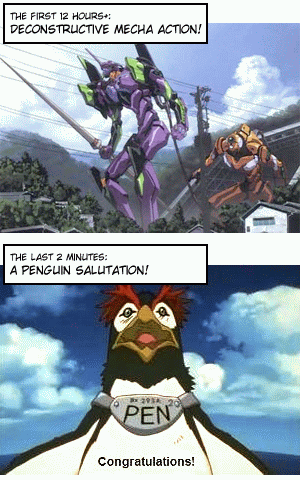 Virgil himself was unsatisfied with the ending and always saw it as incomplete, but was prevented from changing the story by the freakin' Emperor of Rome himself.
Source: Gainax Ending - It's frustratingly incomplete and more like The Patriot than "12 Years a Slave crossed with Braveheart" overall, though Bob admitted he loved the ending.
- Many felt that the ending was incomplete, and in the 15th century, an Italian poet named Maffeo Vegio wrote a continuation for it, which was widely printed in later editions.
Cite this Source
Incomplete and Ending. (2016). Retrieved 2026, July 22, from https://thesaurus.plus/related/ending/incomplete
Ending & Incomplete. N.p., 2016. Web. 22 Jul. 2026. <https://thesaurus.plus/related/ending/incomplete>.
Incomplete or Ending. 2016. Accessed July 22, 2026. https://thesaurus.plus/related/ending/incomplete.


Google Ngram Viewer shows how "ending" and "incomplete" have occurred on timeline